

Concerns about declining snowpack, fish survival, and planning for the future were themes across presentations from WA state and federal agencies at August Council meeting
At its August 2026 meeting in Seattle, Wash., the Council heard important updates from several agencies including the Washington State Climate Office, the Washington State Department of Ecology, the Orca Task Force, and the Northwest Fisheries Science Center/NOAA.
WA State Climate Office
Guillaume Mauger, Washington State Climatologist and a research scientist at the UW Climate Impacts Group, focused on the impacts of last winter’s record-low snowpack for the region as well as the potential additive effects that the predicted strong El Niño year could bring (slides | video). Mauger is also a member of the Climate and Weather Advisory Committee that helped inform the Council’s approach to extreme weather conditions in the draft Ninth Power Plan.
“The most important fact about climate change for our region and for energy in our region is snowpack,” said Mauger. “This is the canary in the coal mine.”
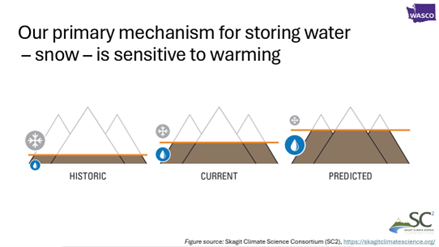
According to Mauger, Washington has seen a 25% decline in peak spring snowpack since 1950. He says that loss is accelerating, with another 50% anticipated loss by the end of the century. The impacts to rivers will be seen most dramatically in basins where mixed rain/snow or snow are dominant, with peak runoff from snow melt decreasing in amount and occurring earlier in the spring, while the winter rain peak will increase. Mauger pointed out some of the hydropower implications of this shift, like less flow happening in summer even as demands for power are increasing.
Some changes to precipitation are also anticipated, with the heaviest winter rain events projected to become more intense, while summer precipitation shows small declines. Mauger cautioned that while these trends haven’t clearly emerged yet given some natural variability in precipitation, even small shifts can ultimately have significant impacts.
Mauger framed his predictions for this year in terms of the similar conditions that occurred in 2015, which was also when the region saw a marine heatwave that has been referred to as “the Blob.”
“As a weather nerd, it wasn’t something I ever expected to see in my lifetime,” he said. It was the warmest year on record for Washington, about 4° F higher than normal; it was dry; and it had the lowest snowpack on record for Washington as well at about 30% of average. The consequences were severe, according to Mauger- over 250,000 Columbia River sockeye salmon died as a result of warmer waters and lower flows; it resulted in the most severe wildfire season in recorded history with over 1 million acres burned; and there were additional impacts in the recreation and agriculture sectors. And this could be the new normal for temperatures and precipitation in 50 years.
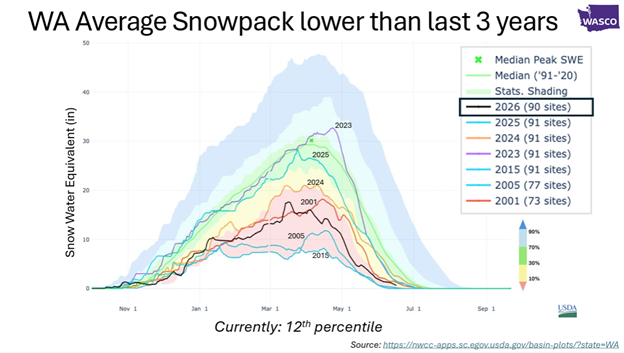
And then there’s the issue of the El Niño effect, which can bring warmer weather in the fall and winter and further reduce snowpack. “Super El Nino is not a technical term, but ‘very strong’ El Nino is. [And] it does look like we have a very high probability of a very strong El Nino,” predicted Mauger.
WA State Department of Ecology
Casey Sixkiller, Director of the Department of Ecology, presented on Ecology’s work to protect communities, farmers and tribes (slides | video).
Director Sixkiller first spoke about wildfires, including the ones that recently swept through residential areas of Spokane as well as the over 3.5 million acres that have burned throughout the region so far this year, and how he views the role of Ecology in the current moment.
“People often think of us as the agency that issues permits and writes regulations, and we do those things. It’s important tools in our toolbox. But our work is ultimately about something that is much bigger. It’s about protecting the things that people count on every day. Clean water and air, healthy communities, and the places that make Washington home. And increasingly, it’s about helping Washington prepare for a future that we know is going to look different from our past.”
Sixkiller echoed some of the themes from the Climate Office’s presentation. Washington has experienced drought in 7 out of the last 10 years, and much of the water that used to arrive as snow in the mountains is now rain he said before announcing the launch earlier this year, with Governor Ferguson, of Washington’s Water Future.
“And that’s one reason I wanted to come speak to all of you. Because the more time I spend talking with people about the future of water, the more I realize we’re having a remarkably similar conversation about the future of energy. Water and power have always been connected in the Northwest. Our rivers powered communities and industries and helped build one of the strongest economies in the country. Abundant, affordable electricity became part of the Northwest’s identity, and conservation became part of our identity too. But just as the assumptions underlying our water system are changing, the assumptions underlying our energy system are changing as well.”
Sixkiller also emphasized the importance of energy conservation, and the Council’s role in making that an intrinsic part of the region’s power system.
“The truth is, conservation has been one of the Northwest’s great success stories. For decades, this region has understood something pretty fundamental. The cheapest and cleanest megawatt is often the one we don’t have to generate in the first place. The principle matters as much today as it ever has, probably more. Efficiency, demand response, demand flexibility, better buildings and equipment and storage, using the system we already have more intelligently. We should squeeze every reasonable megawatt we can out of these opportunities, because every megawatt we don’t need to generate or move to a different part of the day means less pressure on the system and potentially less infrastructure that we have to build. That’s good for ratepayers, communities, and the environment…
So conservation has to remain a strategic and critical component of the Northwest’s energy future, but it can’t carry the entire load that’s coming. We’re going to need more electricity. So this isn’t a choice between conservation or generation, or between efficiency and transmission, between using what we have versus building what we need next. We’re going to need all of it...but [first] we have to understand the size of the challenge, and that’s one of the most important roles that this Council plays.”
He concluded by emphasizing the regional nature of both power and water, and the importance of collaboration and cooperation.
“Things are still possible when we work together. I think that’s sort of the bottom line.”
Orca Task Force Recommendations
In 2018, former Governor Inslee created the Southern Resident Killer Whale Task Force and issued Executive Order 18-02 to support recovery efforts. Washington Council Member Les Purce served as Co-Chair during the Task Force’s duration from 2018-2019. Tara Galuski, Orca Recovery Coordinator, Governor’s Salmon Recovery Office, provided insights on the progress made on the Task Force’s recommendations (slides | video).
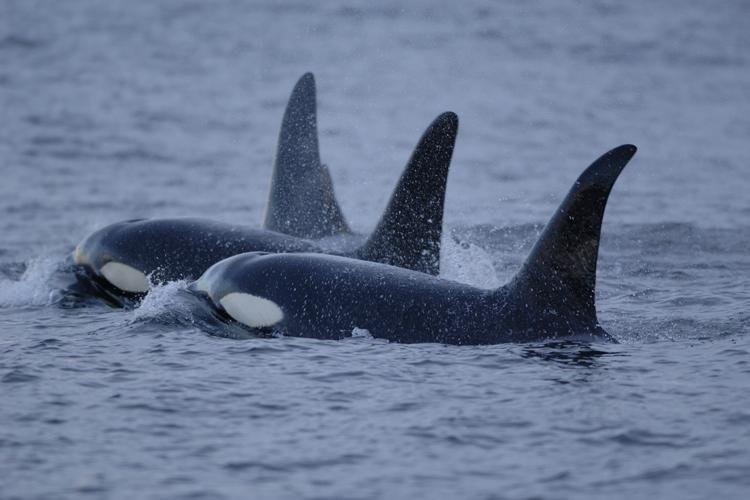
There are 3 types of killer whales, also known as orcas, in this region: offshore, known to feed on sharks; transients, known to feed on seals and sea lions, and whose numbers may be increasing as a result of increases in those prey populations; and Northern and Southern Residents, which primarily eat fish and in particular Chinook salmon. Southern Resident killer whales were listed as endangered in 2005.
Galuski outlined the main threats to the Southern Residents as noise disturbance from vessels; pollution and contaminants that impact reproduction; and a lack of prey fish, particularly salmon; as well as climate change, human population growth, and a small orca population leading to inbreeding. The population was also impacted by the marine mammal trade for aquariums and other businesses in the 1970s. In the late 1990s there were about 100 Southern Resident orca; in 2018 there were 74, and today there are 76.
The Task Force met for over two years, included legislators, tribes, non-profits, and public input, and delivered 49 recommendations.
Galuski reported on progress made by the Task Force, including increased funding from various sources on habitat and hatcheries to support prey populations, particularly Chinook salmon. The next State of the Salmon report is expected to be released in 2026 (read the most recent report from 2024.)
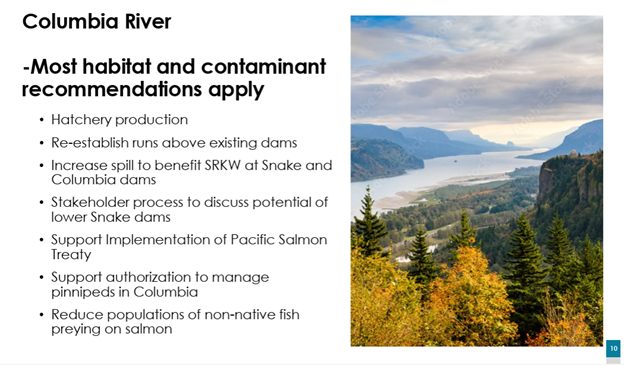
Another area where Galuski noted significant progress made on behalf of the Southern Residents is addressing the impacts of vessels. Ships are engaging in voluntary slowdowns, and a new distance law passed in 2025 increased the mandatory distance of boats from 200 yards to 1,000 yards. A thermal camera installed in Port Townsend helps detect whales and notify boat captains to proceed with caution. Washington also passed new guidelines for commercial whale watching. Progress has also been made on contaminants, including emerging concerns like tire dust or 6PPDE. Galuski thanked Director Sixkiller for Ecology’s support and work with EPA on the issue of contaminants.
“I just have to tell you, I’m in wonderment at the work that went beyond, with this work, the task force, and the various amazing areas that it’s touched with the energy beyond with this,” commented Council Member Purce. “And I can only say to my colleagues, and myself, this is without a doubt one of the most consequential public pieces of service that I’d ever done.”
NOAA Science Center
Jeremy Rusin, Director of the Northwest Fisheries Science Center (NWFSC), stepped in for colleague Fish Ecology Director Scott Hecht to share updates with the Council (slides | video).
NWFSC is part of the National Oceanic and Atmospheric Administration’s (NOAA) organizational structure, under the National Marine Fisheries Service umbrella. They are headquartered in Seattle, with additional research stations located in Manchester, Point Adams, Pasco, and Newport. The Pasco station is the only lab in the U.S. that is focused on researching salmon passage through the hydropower system.
“The vast majority of our mission activities, 80-90%, are focused on providing information needed for in-year management....making sure that the regional office, our headquarters office, the regional fishery management councils, others who are decision-makers, have the information they need to make those decisions,” said Rusin.
But NOAA, as well as other federal agencies, are going through a challenging time for staff. Rusin said that the center saw about a 25% reduction in staff as a result of the early retirements and firing of probationary employees that the administration pursued last spring. This mix brought unique challenges, as retiring employees meant a loss of institutional knowledge, and a reduction in newer staff meant that skills in emerging and advanced technologies were lost. Rusin mentioned that the early retirements also meant the closing of their ecotoxicology program.
Rusin offered up the possibility for new opportunities as a result. “We’re not really going to maintain anything that we’ve done previously. We’re going to rethink and reimagine everything,” he said. Speaking about the cross-cutting nature of their core work, especially field data collection, research, and analytical modeling, Rusin said that they are trying to streamline work, make it more efficient, and reduce costs. He gave examples of running simpler stocked assessments that still answer the main research questions, or using uncrewed ships or fewer people to make surveys more efficient. Rusin also touched on the emerging role of environmental DNA, known as eDNA, and incorporating it into stock assessments.
He also pointed to refocusing the center’s protected resource science, usually work related to protecting endangered species, towards supporting the administration’s priorities of creating fishing opportunities and supporting fisheries, as well as continuing to advance aquaculture and hatchery technology.
Rusin then ran through highlights from a few different projects related to the Council’s work, including developing a better understanding of how hatchery fish can support recovery of ESA-listed steelhead, assessing the long-term survival of Columbia River Basin salmon and steelhead, the impacts of pinniped and other types of predation, the salmon ocean ecology studies led by Brian Burke, and mapping climate impacts.
“The length of time we all have been in this endeavor, nothing’s constant. And some of these contemporary challenges are large, right?” commented Idaho member Ed Schriever. “And they require all of us to be nimble. So I appreciate your recognition of that.”
Legal Disclaimer:
EIN Presswire provides this news content "as is" without warranty of any kind. We do not accept any responsibility or liability for the accuracy, content, images, videos, licenses, completeness, legality, or reliability of the information contained in this article. If you have any complaints or copyright issues related to this article, kindly contact the author above.
